
 Muhammad Naeem
The Jinko 575W N-type Tiger Neo solar panel currently sells in Pakistan between Rs. 17,800 and Rs. 23,600, depending on grade, documentation and the city you buy it in. At the per watt rate that shops are quoting today, roughly Rs. 31 to Rs. 41 per watt, a single 575W panel lands in the low twenties of thousands. That is the quick answer. The longer answer is worth reading if you are about to spend real money, because not every panel stamped with the Jinko name is the same, and the 575W Tiger Neo sits in a busy corner of the market where P-type and N-type models get mixed up in price lists.
This guide lists what Pakistani sellers are actually charging for the Jinko Tiger Neo 575W (N-type), breaks down the real specifications of the panel, and explains how to tell whether the stock a dealer is offering you is the genuine A-grade documented unit you are paying for. Prices change with the dollar and with container arrivals, so always confirm the final rate on the phone before visiting a shop.
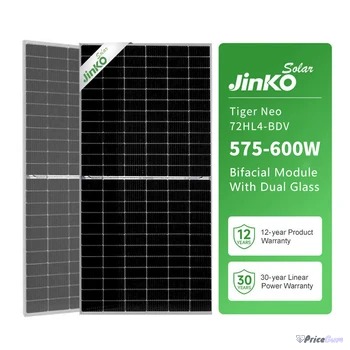
Jinko 575W Tiger Neo Price in Pakistan Today
Solar panel pricing in Pakistan moves on a per watt basis, and the Jinko N-type 575W is no exception. Below is what named Pakistani sellers and daily price trackers are quoting for this exact model class right now.
| Seller / Source | Model Listed | Price per Watt | Panel Price (PKR) |
| Ryksolar Energy (ryksolarenergy.com) | Jinko N-Type 575W Tiger Neo (JKM575N-72HL4-V), A-grade documented | Rs. 32 to Rs. 38 | Rs. 18,400 to Rs. 21,850 |
| solarpriceinfo.com (daily price list) | Jinko N-Type 575W, in stock | Rs. 36.50 | Rs. 20,987 |
| pakistansolarprices.com (daily update) | Jinko N-type 575 watt | Rs. 41 | Rs. 23,575 |
| solarpanelprices.pk | Jinko N Type 575 Watt, A-grade documented | Rs. 31 | Rs. 17,825 |
All four sources were checked on 2 October 2026. The spread between the lowest and highest quote is normal for the Pakistani market. It comes down to three things: whether the stock is documented A-grade with verifiable serial numbers, whether you are buying one panel or a full pallet, and whether the dealer’s container landed this week or last month. If someone quotes you far below Rs. 30 per watt for a claimed Tiger Neo 575W, slow down and check what you are actually being sold. For a broader view of how this panel compares with other brands and wattages, see our solar panel price in Pakistan roundup.
What Is the Jinko Tiger Neo 575W?
The Tiger Neo is Jinko’s N-type TOPCon module line, and the 575W unit is one of its most widely stocked sizes in Pakistan. The model number you will see on dealer lists is JKM575N-72HL4-V for the monofacial version and JKM575N-72HL4-BDV for the bifacial dual-glass version. Both are 144 half-cut cell modules built on 182mm N-type wafers.
N-type matters more than it sounds. Older P-type PERC panels lose output faster because of light induced degradation and higher annual degradation rates. N-type TOPCon cells largely avoid that problem, and they hold their output better in the high heat that rooftops in Lahore, Karachi and Multan reach every summer. That is why dealers charge a small premium for N-type over P-type of the same wattage, and why the Tiger Neo 575W has become the default recommendation from installers doing residential net metering setups.
Jinko Tiger Neo 575W Specifications
| Specification | Detail |
| Model numbers | JKM575N-72HL4-V (monofacial), JKM575N-72HL4-BDV (bifacial) |
| Maximum power (Pmax) | 575 W |
| Cell type | N-type monocrystalline, TOPCon, 144 half-cut cells (6 x 24) |
| Module efficiency | Up to 22.26 percent |
| Dimensions | 2278 x 1134 x 35 mm |
| Weight | 28 kg |
| Front glass | 3.2 mm anti-reflection coated tempered glass (monofacial); dual glass on BDV |
| Frame | Anodized aluminium alloy |
| Junction box | IP68 rated, 3 bypass diodes |
| Power tolerance | 0 to +3 percent |
| Temperature coefficient (Pmax) | -0.29 percent per degree C |
| Product warranty | 12 years |
| Linear power warranty | 30 years |
How Many Tiger Neo 575W Panels Does a Home Need?
A quick way to size a rooftop system: ten of these panels give you 5.75 kW of installed DC capacity. In practice, a 5 kW system in Punjab needs around nine panels at this wattage, a 3 kW system needs about six, and a 10 kW system needs eighteen. Roof space matters too. Each panel covers about 2.58 square metres, so a nine panel array needs roughly 24 square metres of clear, unshaded roof before mounting gaps.
City rates differ slightly from the national average because of transport and stock rotation. Check our city guides for solar panel prices in Lahore and solar panel prices in Karachi if you want to compare what shops there are quoting against these national figures.
Documented vs Non-Documented Stock: Why the Price Differs
You will notice dealers using the words documented and A-grade in their price lists. Documented means the panel ships with its factory serial numbers intact, its flash test report, and warranty paperwork that Jinko or its official distributor will honour. Non-documented or B-grade stock is cheaper per watt but carries real risk: lower actual output, no meaningful warranty, and sometimes panels that failed factory binning.
For a panel you expect to run for 25 years, the small per watt saving on undocumented stock is rarely worth it. Ask the dealer three questions before paying: can I verify the serial number with the distributor, is the flash test report available, and will the warranty claim go through Jinko or just through the shop? If the answer to any of these is vague, walk away and get a quote from another dealer. The genuine unit also carries the factory barcode on the frame and the data label on the backsheet with voltage, current and certification marks.
How the Tiger Neo 575W Compares With Nearby Options
Two panels that shoppers in Pakistan compare against this one are the JA Solar 545W and the Risen 585W. The JA 545W is usually cheaper per panel because it is a lower wattage P-type unit, so you need more panels and more roof space for the same system size. The Risen 585W sits at a slightly higher wattage and price point. The Tiger Neo 575W tends to win on the middle ground: modern N-type cells, strong warranty terms, and a per watt rate that has settled into the low to mid thirties for documented stock.
- Genuine N-type TOPCon cells with up to 22.26 percent efficiency, meaning fewer panels needed for the same system size
- Very low degradation: near zero light induced degradation and only about 0.3 percent annual power loss, so output holds up over decades
- Strong warranty package: 12 year product warranty plus 30 year linear power warranty, above what most P-type panels offer
- Good heat behaviour with a -0.29 percent per degree C temperature coefficient, important for Pakistani summers
- Widely stocked by Pakistani dealers with verifiable serial numbers, so genuine documented units are actually findable
- Costs a few rupees more per watt than P-type panels of similar wattage, which adds up on larger systems
- At 2278 x 1134 mm and 28 kg it is a large, heavy panel that needs solid mounting and careful handling on the roof
- Fake and B-grade units with the Jinko name circulate in the market, so buying blind from an unknown seller is risky
- Price shifts with the dollar and container arrivals, so a quote from last month may not hold today
Frequently Asked Questions
What is the current price of the Jinko 575W Tiger Neo in Pakistan?
As of October 2026, Pakistani sellers list it between Rs. 17,800 and Rs. 23,600 per panel, which works out to roughly Rs. 31 to Rs. 41 per watt for documented A-grade stock. Confirm the final rate with the dealer before purchase.
Is the Jinko Tiger Neo 575W an N-type panel?
Yes. The Tiger Neo line is Jinko’s N-type TOPCon range. Do not confuse it with older Jinko P-type models such as the Tiger Pro; check the model number JKM575N on the backsheet label, where the N denotes N-type.
What is the difference between the V and BDV versions of the 575W panel?
JKM575N-72HL4-V is the monofacial version with a white backsheet, while JKM575N-72HL4-BDV is the bifacial dual-glass version that can capture reflected light from the back side. For a normal rooftop with the panel mounted close to the surface, the monofacial version is usually the better value.
How can I verify a Jinko panel is genuine?
Check the factory serial number on the frame barcode, ask for the flash test report, and buy from a dealer who can trace the warranty through Jinko’s official channel. Genuine documented panels also carry certification marks (IEC 61215, IEC 61730) on the backsheet data label.
How many units will one 575W panel produce per day?
In most of Punjab and Sindh, a 575W panel facing the sun with no shade produces roughly 2.5 to 3 units (kWh) per day on average across the year, more in summer and less in winter. A nine panel array therefore yields around 22 to 27 units daily.


Add comment