
 Muhammad Naeem
Short answer: you need 5 to 6 solar panels of 580W to 585W to run a 1.5 ton inverter AC in Pakistan during the day, paired with a 3kW hybrid inverter. If you also want the AC to keep running after sunset or during load shedding, keep the same 5 to 6 panels, use a 3kW or 5kW hybrid inverter, and add a battery bank sized for the hours you want. Four panels can start the AC on a clear midday, but the system will trip or lean on the grid whenever a cloud passes or other loads switch on. This guide shows the load math, the panel count for each setup, and what the full system actually costs at prices checked on 1 October 2026.
How much power does a 1.5 ton inverter AC actually use?
A 1.5 ton inverter AC does not pull one fixed wattage. On a typical Pakistani summer day it behaves like this:
| Stage | Typical draw | What it means for solar sizing |
| Start-up ramp | Rises gently to about 1,500 to 1,800W, no hard surge | Inverter ACs soft-start, so there is no 3x to 4x starting surge like an old non-inverter AC. Your solar inverter does not need a huge surge rating just for the AC. |
| Full cooling, hot afternoon | About 1,300 to 1,600W | This is the peak your panels must cover around 1pm to 3pm in May to July. |
| Room cooled, compressor throttled | About 700 to 1,100W | Most of the evening running sits here. Battery backup hours are calculated on this lower figure. |
Two honest cautions. First, these are typical ranges for common 1.5 ton inverter models sold in Pakistan, not a promise for your exact unit; check the rated input watts on the sticker of your outdoor unit. Second, panels do not give their sticker wattage at noon in Lahore heat. A 585W panel usually delivers around 430 to 470W in real midday conditions after temperature and wiring losses. That gap is exactly why installers who quote “3 panels are enough” leave buyers disappointed.
The quick answer box
| Your goal | Panels (585W) | Array size | Inverter | Battery |
| AC only, daytime, grid support allowed | 4 | 2.34kW | 3kW hybrid | None, grid fills the gaps |
| AC plus fans, lights and fridge, daytime | 5 to 6 | 2.93 to 3.51kW | 3kW hybrid | None, or small battery for load shedding |
| AC day and night with backup | 6 | 3.51kW | 3kW or 5kW hybrid | 48V 100Ah lithium (about 5kWh) for roughly 3 to 4 hours of AC at night |
| Two ACs or a bigger house load | 9 to 10 | 5.27 to 5.85kW | 5kW hybrid | Size to your night hours |
Why 5 to 6 panels, in plain math
Take the recommended 6 x 585W setup. Nameplate capacity is 3.51kW. At a realistic 75 to 80 percent midday output, the array gives you about 2.6 to 2.8kW of usable power in strong sun. Against that, your load is roughly 1,400W for the AC at full tilt plus 300 to 500W for the fridge, fans and lights that are always on. That leaves healthy headroom for clouds and for the late afternoon when the sun angle drops. Drop to 4 panels (2.34kW nameplate, about 1.8kW real) and the AC alone nearly maxes the array, so the inverter quietly pulls the rest from WAPDA. That is not a failure, but you should know you are buying partial savings, not full daytime independence.
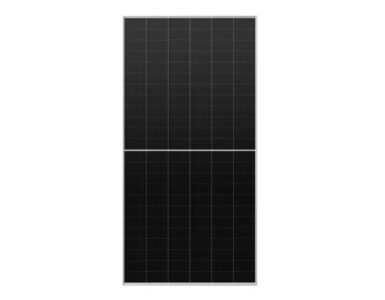
Panel choice matters less than panel count at this size. The current 580W and 585W tier-1 panels from Longi, Jinko, JA Solar and Canadian Solar all sit within a few percent of each other, and we track their rates in our 580W solar panel price guide and 585W solar panel price guide. Brand-by-brand rates are in the Longi price list, the Jinko price list and the JA Solar price list.
Daytime-only vs hybrid with batteries
Panels with grid support (no battery). A hybrid inverter without a battery, or with a token battery only for fans and lights, runs the AC from solar while the sun is up and blends grid power when clouds pass. This is the cheapest way to cut the AC bill, and it is what most 3kW installs in Pakistan actually do. The catch: during daytime load shedding with no battery, many hybrid inverters shut the AC output down or limit it, so ask your installer exactly what happens at 2pm when the grid goes.
Hybrid with a real battery. Night running is a battery question, not a panel question. Once the room is cool, a 1.5 ton inverter AC sips roughly 700 to 1,100W. A 48V 100Ah lithium battery stores about 5kWh, of which roughly 4.5kWh is safely usable, so expect around 4 to 5 hours at the throttled draw, less if the room is still hot. A cheaper tubular battery setup of the same nominal size gives fewer usable hours and a shorter life under daily AC cycling. If your main pain is the night bill rather than load shedding, also compare a full 3kW solar system against a 5kW solar system, because the 5kW leaves room for a second AC later.
Inverter sizing: 3kW or 5kW?
For one 1.5 ton inverter AC plus normal home load, a 3kW hybrid inverter is the right pairing: its solar input comfortably takes 6 x 585W panels and its output covers the AC with room to spare. Step up to a 5kW hybrid only if you plan a second AC, a motor pump on the same system, or more panels next year. Oversizing the inverter today “just in case” wastes money; undersizing it blocks every future panel you add. Current Inverex Nitrox class rates we checked: the Nitrox 3kW hybrid sits around Rs. 185,000 to Rs. 190,000, and 5kW class hybrid models sit around Rs. 240,000 to Rs. 260,000, depending on city and warranty terms. Always confirm whether the quote is for the IP65 Nitrox model and what the service network looks like in your city. You can cross-check panel and system rates any time on our solar panel price in Pakistan hub, and read about the panel maker at the official LONGi website.
What the full setup costs, honestly
Panel prices below are the dated market rates we fetched on 1 October 2026 from Pakistani solar rate lists. Inverter and battery figures are from Pakistani seller and rate-list pages checked the same day. Structure and installation ranges come from published installer cost breakdowns for 3kW and 5kW systems. City, roof type and cable length move every one of these numbers, so treat the totals as a budget frame, not a quotation.
| Item | Figure used | Source checked 1 Oct 2026 |
| 585W panel, JA Solar N-Type bifacial | Rs. 25,155 per panel | Pakistani solar rate list dated 1 October 2026 |
| 585W panel, Jinko | Rs. 27,495 per panel | Same dated rate list |
| 585W panel, Canadian Solar | Rs. 27,495 per panel | Same dated rate list |
| 580W panel, Astronergy N-Type bifacial | Rs. 24,360 per panel | Same dated rate list |
| 3kW hybrid inverter (Inverex Nitrox class) | Rs. 185,000 to Rs. 190,000 | Two Pakistani inverter price pages |
| 5kW hybrid inverter class | Rs. 240,000 to Rs. 260,000 | Pakistani inverter price page |
| 48V 100Ah lithium battery (Inverex) | Rs. 255,000 | Pakistani inverter and battery rate list |
| Mounting structure plus installation, 3kW | Rs. 40,000 to Rs. 60,000 | Installer cost breakdown for 3kW systems |
| Mounting structure plus installation, 5kW | Rs. 60,000 to Rs. 80,000 | Installer cost breakdown for 5kW systems |
Worked total, daytime setup: 6 x 585W JA Solar panels at Rs. 25,155 come to Rs. 150,930. Add a 3kW Nitrox class inverter at Rs. 185,000 to Rs. 190,000 and structure plus installation at Rs. 40,000 to Rs. 60,000, and you land around Rs. 3.76 lakh to Rs. 4.01 lakh before DC cabling, breakers and net-metering paperwork, which vary by house and DISCO. Worked total, with night backup: add the 48V 100Ah lithium battery at Rs. 255,000 and the same system lands around Rs. 6.31 lakh to Rs. 6.56 lakh. Anyone quoting you far below these frames is usually cutting the battery, the structure gauge, or the panel grade, so ask which one.
- 5 to 6 modern 585W panels genuinely cover a 1.5 ton inverter AC plus basic home load in daytime sun.
- Inverter ACs soft-start, so a standard 3kW hybrid inverter handles the AC without surge problems.
- A hybrid setup lets you add a battery later instead of paying for night backup on day one.
- Panels are the cheapest part of the system now, so oversizing the array slightly is money well spent.
- Four-panel quotes look cheap but leave the inverter blending grid power most of the afternoon.
- Night AC running is expensive: the battery alone can cost more than the panels and inverter combined.
- Real panel output in Pakistani summer heat is 20 to 25 percent below the sticker wattage.
- Rates move with the dollar and city stock, so a quote older than a few weeks is not reliable.
Frequently asked questions
Can 4 solar panels run a 1.5 ton inverter AC?
Yes, on a clear day around noon, 4 x 585W panels (2.34kW) can start and run a 1.5 ton inverter AC on their own. The problem is everything around that moment: clouds, a fridge compressor kicking in, or late-afternoon sun will push the inverter to draw from the grid or trip on overload. For dependable daytime running, 5 to 6 panels is the honest recommendation.
How many panels do I need to run a 1.5 ton AC at night?
Panels do nothing at night; the battery decides. With the room already cool, a 1.5 ton inverter AC draws roughly 700 to 1,100W, so a 48V 100Ah lithium battery (about 5kWh) gives around 4 to 5 hours. You still want 5 to 6 panels so the battery is fully recharged the next day while the AC also runs.
Is a 3kW inverter enough for a 1.5 ton inverter AC?
Yes. A 3kW hybrid inverter covers the AC at full draw (about 1,300 to 1,600W) plus fans, lights and a fridge, and it accepts the 6-panel array this guide recommends. Choose a 5kW inverter only if a second AC or a future panel expansion is planned.
What is the total cost of solar for a 1.5 ton AC in Pakistan?
At prices checked on 1 October 2026, a daytime system with 6 x 585W panels and a 3kW hybrid inverter lands around Rs. 3.76 lakh to Rs. 4.01 lakh before cabling and net-metering costs. Adding a 48V 100Ah lithium battery for night backup takes it to roughly Rs. 6.31 lakh to Rs. 6.56 lakh.
Prices and rates in this guide were checked on 1 October 2026 from Pakistani seller and rate-list pages. Solar prices move quickly, so confirm the panel rate and inverter model with your installer before paying an advance.


Add comment