
 Muhammad Naeem
If you are building a 1080p gaming PC in Pakistan right now, these are the two cards most shops will quote you first. The NVIDIA GeForce RTX 4060 starts at Rs 103,000 to Rs 107,990 for a ZOTAC Twin Edge card, while the AMD Radeon RX 7600 Sapphire PULSE sits at Rs 89,990 to Rs 92,500, checked October 2026. Both are 8GB cards on a 128-bit bus, so on paper they look close. The real gap is not memory size. It is what each card does with upscaling, ray tracing and power draw.
Shop stock is patchy. EezePC listed the ZOTAC RTX 4060 Twin Edge at Rs 107,990 and out of stock at the time of checking, with a GIGABYTE Gaming OC variant at Rs 127,990, also out of stock. Elite Gaming Store quoted the same Zotac card at Rs 116,999. On the AMD side, JunaidTech listed the Sapphire PULSE RX 7600 at Rs 91,499 with a 2-year local warranty and EezePC at Rs 89,990, both out of stock in the spot check. Prices move fast, so confirm the exact board partner and part number in writing before you pay.
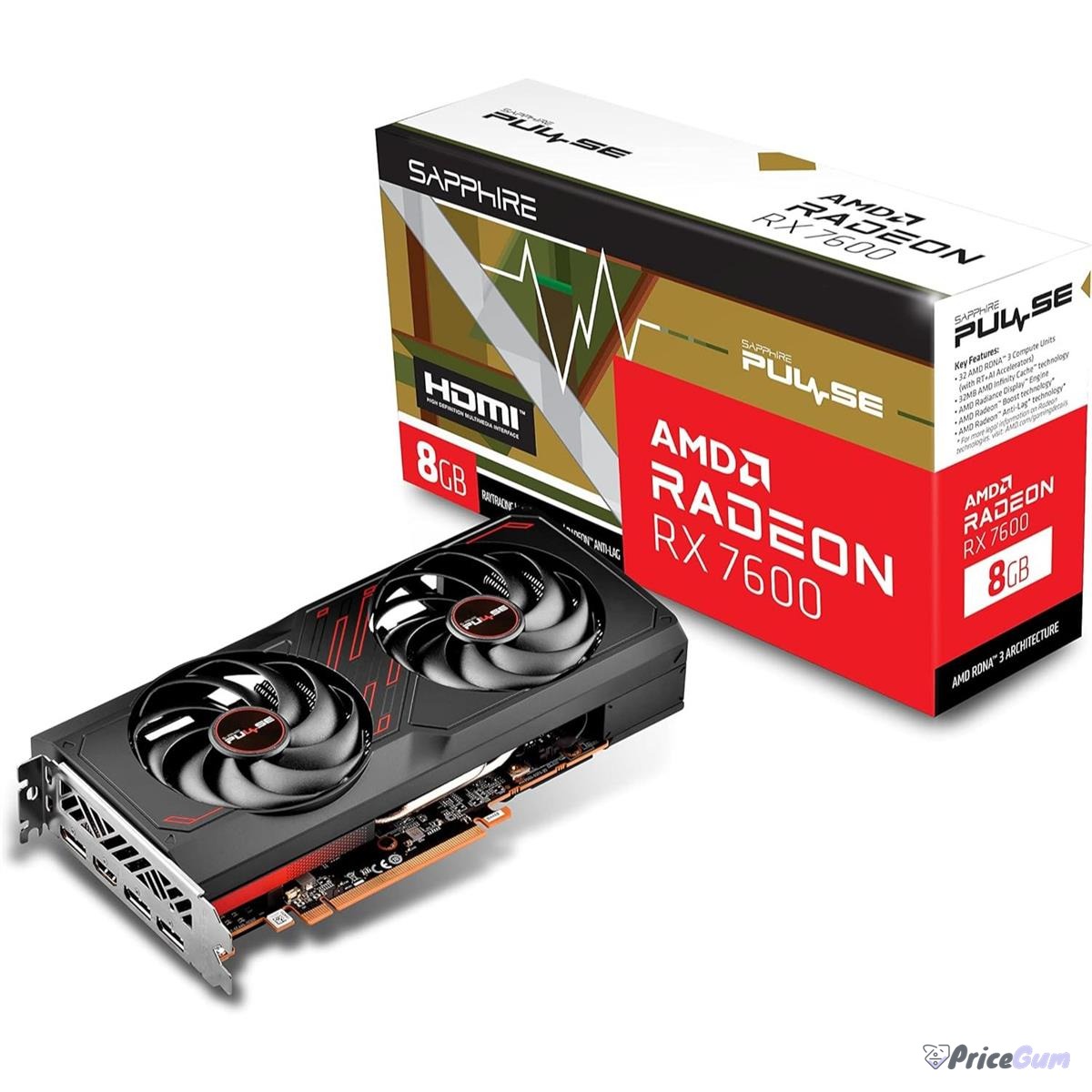
Side by side specs
| Spec | RTX 4060 (ZOTAC Twin Edge) | RX 7600 (Sapphire PULSE) |
| GPU | AD107, 3,072 CUDA cores | Navi 33 RDNA 3, 2,048 stream processors, 32 CU |
| Memory | 8GB GDDR6, 128-bit, 17 Gbps, 272 GB/s | 8GB GDDR6, 128-bit, 18 Gbps, 32MB Infinity Cache |
| Boost clock | Up to 2,460 MHz | Boost up to 2,755 MHz, game clock up to 2,355 MHz |
| Interface | PCIe 4.0 x8, 3x DisplayPort 1.4a, 1x HDMI 2.1a | PCIe 4.0 x8, 3x DisplayPort, 1x HDMI |
| Power | 115W, 1x 8-pin, 500W PSU recommended | 1x 8-pin, 550W PSU recommended |
| Length | 221.4mm, fits most mid towers | 240mm long, 107.1mm wide, 44.07mm thick |
| Pakistan price anchor | Rs 103,000 to Rs 107,990 new | Rs 89,990 to Rs 92,500 new |
Both cards use a PCIe x8 link, so a PCIe 3.0 motherboard still runs them, but you leave a few frames on the table. The ZOTAC card is the smaller and cooler option. The Sapphire card is a touch longer but still a standard two slot design. If your case is tight, measure before you order. Board partner clocks and cooler designs change street prices more than the chip name does, so compare part numbers, not just RTX 4060 versus RX 7600 labels.
Price evidence in Pakistan, checked October 2026
| Product and config | Seller | Price (Rs) | Condition and note |
| RTX 4060 ZOTAC Twin Edge 8GB (ZT-D40600E-10M) | ZI Computers | 103,000 | New, listed out of stock |
| RTX 4060 ZOTAC Twin Edge 8GB | EezePC | 107,990 | New, listed out of stock in spot check |
| RTX 4060 ZOTAC Twin Edge 8GB | Elite Gaming Store | 116,999 | New retail ask |
| RX 7600 Sapphire PULSE 8GB | EezePC | 89,990 | New, listed out of stock |
| RX 7600 Sapphire PULSE 8GB | JunaidTech | 91,499 | New, 2-year local warranty, listed out of stock |
| RX 7600 Sapphire PULSE 8GB | Zestro Gaming | 92,500 | New retail ask |
| RX 7600 Sapphire PULSE 8GB refurbished | JunaidTech | 69,999 | Factory refurbished, 3-month warranty, listed out of stock |
The honest read is simple. At street prices the AMD card is about Rs 13,000 to Rs 18,000 cheaper for the same memory size. That gap pays for a better power supply or a faster SSD. The refurbished RX 7600 at Rs 69,999 is a different purchase with a 3-month warranty, so do not treat it as the new price. If you want the step up in the NVIDIA stack, look at the RTX 4060 Ti 8GB. If you want to save more, the RX 6600 still shows up in local builds for less money. For used buying safety, read our used graphics card buying guide before touching marketplace listings.
1080p gaming: the value pick
At 1080p native, the RX 7600 holds its own. In rasterised games without heavy ray tracing, frame rates are close enough that most players would not name the winner in a blind test, and the AMD card costs less. If your library is esports titles, FIFA, Valorant, Apex or older AAA games, the Sapphire card gives you more frames per rupee. The RTX 4060 does not run away in basic raster performance, so paying more only makes sense when you use the NVIDIA features.
DLSS, FSR and ray tracing: the NVIDIA edge
This is where the RTX 4060 earns its premium. DLSS Super Resolution is cleaner in motion than FSR on an 8GB card, and frame generation helps in supported games when the CPU is not the limit. Ray tracing is also stronger on NVIDIA at this tier, though both cards still ask for upscaling to hit smooth rates. If you play Cyberpunk 2077, Alan Wake 2 or Metro Exodus Enhanced and you want ray tracing on, pick the RTX 4060. If you keep ray tracing off, the RX 7600 value case gets stronger again. AMD counters with lower price and a simple driver stack that many builders like.
VRAM honesty: both cards stop at 8GB
Neither card gives you more memory. Eight gigabytes is fine for 1080p today with sensible texture settings, and it is tight in some new ports that were built for current consoles. You will turn textures down in the worst cases whether you buy red or green. A 128-bit bus on both cards also limits memory bandwidth tricks. If VRAM is your main worry, saving toward a 12GB or 16GB card makes more sense than switching between these two. Look at the RTX 3060 12GB listings only if you accept older architecture and slower ray tracing.
Power, size and noise
The RTX 4060 wins on efficiency. At 115W it runs cool in a modest case and works with a 500W power supply, which matters in Pakistani homes where a good PSU is not cheap. The RX 7600 asks for a 550W unit and pulls more power under load. Both cards use a single 8-pin connector. The ZOTAC Twin Edge at 221.4mm is shorter than the Sapphire at 240mm, so small cases favour NVIDIA here. Noise depends on the cooler, and both brands are fine at stock settings.
Pros and cons at a glance
- RX 7600 is about Rs 13,000 to Rs 18,000 cheaper at street prices
- Strong 1080p raster performance on the Sapphire PULSE
- RTX 4060 adds DLSS frame generation and better ray tracing
- RTX 4060 uses only 115W and suits a 500W power supply
- Both cards stop at 8GB VRAM on a 128-bit bus
- PCIe x8 link on both cards, so PCIe 3.0 boards lose a little speed
- Local stock was out of stock at several sellers in October 2026 checks
- Board partner prices vary widely, so confirm the part number in writing
Frequently Asked Questions
Which card is better for 1080p gaming?
The RX 7600 for value. It costs Rs 89,990 to Rs 92,500 at local sellers and matches the RTX 4060 closely in standard rasterised games at 1080p.
Is DLSS worth the extra money for the RTX 4060?
Yes if you use it. DLSS Super Resolution plus frame generation and stronger ray tracing justify the Rs 103,000 to Rs 107,990 price for players who turn those features on.
Will 8GB VRAM be enough in 2026?
For 1080p with medium to high textures, mostly yes. For the newest ports at ultra textures you will lower settings on either card. Neither model fixes that limit.
What power supply do I need?
A decent 500W unit suits the RTX 4060. Buy a 550W unit for the RX 7600. Both cards need one 8-pin PCIe power connector.


Add comment