
 Muhammad Naeem
A 300W solar panel in Pakistan costs between Rs. 13,000 and Rs. 16,500 from most sellers right now, which works out to roughly Rs. 45 to Rs. 55 per watt. Budget local options like Maysun start as low as Rs. 9,600 for a 300W A-grade panel, while tier-1 brand stock from Longi, JA Solar, Jinko, Trina and Canadian Solar sits at the top of the range. This is a mid-range wattage class that has become harder to find in branded retail, so prices are mostly set by clearance stock, dealer listings and the second-hand market rather than official brand rate cards.
The 300W panel is a bit of an in-between size in 2026. It is too big for tiny single-battery DC kits and too small for modern home systems, where installers now reach straight for 550W to 585W panels that cost far less per watt. Still, there is steady demand from shops running a couple of fans and lights, small DC tube-well setups, farm sheds, and people adding one more panel to an older system. If that is your situation, this price guide covers what a 300W panel actually costs across brands, what you get for the money, and the honest reasons most buyers end up sizing up.
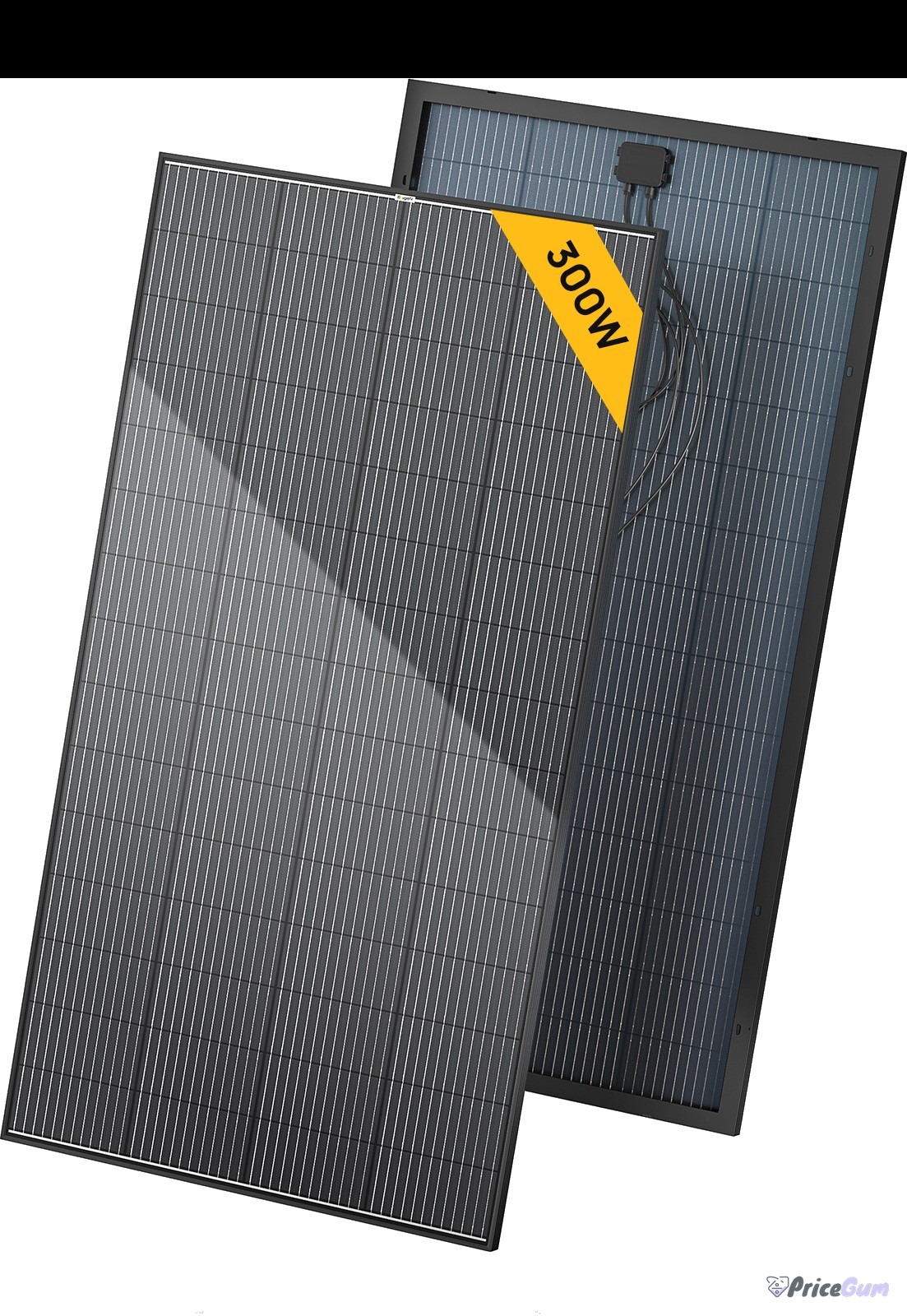
300W Solar Panel Price in Pakistan: Latest Brand Rates
Based on live seller listings checked on 2 October 2026, here is where 300W-class panel prices sit across brands and sources. Per-watt figures are included because that is the only honest way to compare a 300W panel against the 550W panels everyone is selling today.
| Panel | Type | Price (PKR) | Per Watt (PKR) |
| Longi 300W | Mono PERC | 13,500 – 16,500 | 45 – 55 |
| JA Solar 300W | Mono / Poly | 13,500 – 15,500 | 45 – 52 |
| Jinko 300W | Mono PERC | 14,000 – 16,000 | 47 – 53 |
| Canadian Solar 300W | Mono | 13,000 – 16,000 | 43 – 53 |
| Trina 300W | Mono / Poly | 13,500 – 16,000 | 45 – 53 |
| Maysun 300W (A-grade) | Mono, local | 9,600 | 32 |
| Tesla PK 300W Mono | Mono, local | 15,300 | 51 |
| Double-glass 300W (dealer) | Bifacial | 14,900 | 50 |
| Jasco 330W (close class) | Mono | 15,000 | 45 |
| 550W tier-1 panel (for comparison) | Mono | 18,000 – 25,000 | 30 – 45 |
The last row of that table is the important one. A branded 550W panel from the same tier-1 makers costs around Rs. 18,000 to Rs. 25,000, which means you pay only a little more than a 300W panel and get nearly double the output. That single fact shapes everything else in this guide, because it explains why 300W panels are getting harder to buy new and why the per-watt price in this class is stubbornly higher.
Where These Prices Come From
Prices above are grounded in three sets of current Pakistani sources, all checked on 2 October 2026. First, Power House Express, an online solar store that keeps an updated per-wattage price table, lists the 300-400W class at Rs. 60-75 per watt (an estimated Rs. 18,000-30,000 per panel) and the 200-300W class at Rs. 80-100 per watt in its August 2026 update. Second, fresh OLX Pakistan seller listings show 300W A-grade panels at Rs. 15,000 in Bahawalpur, a 300W A-grade panel at Rs. 14,400 and a double-glass 300W at Rs. 14,900 in Lahore, a Canadian 300W at Rs. 13,000 and a generic 300W at Rs. 13,000 in Karachi, and two 300W panels with stands for Rs. 32,000 in Rawalpindi. Third, a Pakistani solar price tracker puts the 300W market band at Rs. 13,500-16,000 (Rs. 45-53 per watt) across JA Solar, Trina and Longi stock.
One older data point is worth mentioning for context. A 2023 brand price table listed JA 300W Poly at Rs. 14,800, Jinko 300W at Rs. 15,000 and Canadian 300W at Rs. 16,000. Three years later, the same class sells for roughly the same money. Prices in this wattage have been flat because the panels themselves are mostly older-generation stock; the market has moved its discounts and volume deals to 540W-plus panels instead.
Who Actually Buys 300W Panels
The buyers of 300W panels are a specific crowd, and it helps to know whether you are one of them before spending the money.
Small DC systems. A single 300W panel paired with a PWM or MPPT charge controller and a battery runs DC fans, LED lights and mobile charging for a shop, clinic or village home. Two panels make a decent 600W starter that runs a room cooler. If you are sizing a small DC setup, our 180W solar panel price guide covers the smaller sibling class.
Adding to an old array. People who installed 300W-class panels five or six years ago sometimes need one matching panel to replace a cracked unit or extend a string. Mixing a new 300W panel with an old one is electrically fine as long as voltages are close, which is why matching wattage still sells.
Shops and small tube wells. A couple of 300W panels on a shop roof can offset daytime fan and lighting load without an inverter, and small farmers use them to top up batteries for low-power pumps. Here the compact panel size is a real advantage, because a 300W panel is about 1.65 by 1.0 metres and much easier to mount on a cramped shop roof than a full-size 550W panel.
Backup additions. Homeowners with an existing small inverter sometimes add a 300W panel to cover one more fan or a few extra lights during outages. For a proper small hybrid setup, the Inverex Veyron II 1.2kW is the kind of 12V hybrid inverter this size of panel usually pairs with.
Mono vs Poly in the 300W Class
Most 300W panels you will find in the Pakistani market today are monocrystalline PERC, because the tier-1 brands discontinued their polycrystalline lines years ago. New old stock and dealer listings labelled “300W poly” are older inventory, and there is nothing wrong with that as long as you pay a poly discount for it. A fair rule of thumb is that poly 300W stock should cost Rs. 1,500 to Rs. 3,000 less than an equivalent mono panel.
Efficiency in this class is typically 17 to 19 percent, against 21 percent plus for current 550W panels. In practical terms, a 300W panel produces roughly 1.2 to 1.5 units per day in Pakistani sunshine, depending on the city and season. Two 300W panels give you about 2.5 to 3 units a day, which covers a couple of fans, lights and phone charging with margin.
One honest caution applies here more than in any other wattage class. Because 300W panels are mostly old or clearance stock, the risk of B-grade or re-labelled panels on the open market is higher. Buy from a dealer who will show you the flash test label, check the serial numbers against the brand, and insist on a written warranty. A 300W panel sold with no warranty at a “too good” price is exactly where fakes hide.
The Honest Case for Sizing Up
If you are buying a panel for a house roof and have the space for it, do the math on a 550W panel before you commit to 300W. At current per-watt panel prices in Pakistan, a tier-1 550W to 585W panel costs Rs. 18,000 to Rs. 25,000, which is only Rs. 3,000 to Rs. 9,000 more than a 300W panel for almost twice the output. A Risen 585W panel, for example, is current-generation stock with a full warranty chain, while most 300W panels on the market are legacy stock with thinner support.
The 300W class still wins in three situations: tight roof space where a smaller panel physically fits and a 2.1-metre panel does not, matching existing 300W strings, and small DC systems where one 300W panel is the right size anyway. Everywhere else, the 550W panel is the better buy in 2026, and it is not close.
What to Check Before You Pay
Three quick checks separate a fair deal from a regret in this wattage class. First, divide the asking price by 300 and compare the per-watt figure against the table above. If someone wants Rs. 20,000 for a used 300W panel, that is Rs. 66 per watt, more than double the cost of a new 550W tier-1 panel, and you should walk away. Second, confirm the panel dimensions and cell count against the brand datasheet; a genuine 300W mono panel has 60 or 72 cells in a roughly 1.65 by 1.0 metre frame. Third, for used panels, ask for a daytime output test. A healthy 300W panel should read close to its rating in full sun; anything under 240W suggests heavy degradation or a B-grade cell batch.
- Compact size fits small roofs, shop awnings and farm sheds where full-size 550W panels physically cannot go.
- Right-sized for single-panel DC systems with a charge controller and battery, so you do not overspend on generation you cannot store.
- Matches existing older arrays, letting owners replace a cracked panel or extend a 300W string without rewiring for different voltages.
- Lower upfront ticket than any 550W panel, which suits tight budgets and single-purpose setups like shop lighting or a backup addition.
- Lighter and easier to handle and mount on a single-storey roof without extra labour or heavy mounting structures.
- Worst per-watt value in the market at Rs. 45-55/W, roughly 50% more expensive per watt than current 550W tier-1 panels.
- Mostly legacy and clearance stock from tier-1 brands, so model choice, warranty support and authenticity are weaker than in the 550W class.
- Higher fake and B-grade risk on the open market, especially in used listings where flash labels can be faked.
- Older 17-19% efficiency, so you need nearly twice the roof space of a 550W panel to get the same output.
- Poor fit for grid-tied home systems, where installers standardise on 550W-plus panels and string designs built around them.
FAQs
What is the price of a 300W solar panel in Pakistan in 2026?
A 300W solar panel costs between Rs. 13,000 and Rs. 16,500 in Pakistan, based on seller listings checked on 2 October 2026. That is roughly Rs. 45 to Rs. 55 per watt. Budget local brands like Maysun go as low as Rs. 9,600, while tier-1 brands such as Longi, JA Solar, Jinko, Trina and Canadian Solar sit between Rs. 13,500 and Rs. 16,500 for this wattage.
How many units does a 300W solar panel produce per day in Pakistan?
A 300W panel produces about 1.2 to 1.5 units (kWh) per day in Pakistani conditions, assuming roughly 5 peak sun hours and typical system losses. Two 300W panels give around 2.5 to 3 units a day, which covers a couple of DC or AC fans, LED lights and mobile charging with room to spare.
Is a 300W panel enough for a home in Pakistan?
For a full home, no. One 300W panel cannot run a house, and even four of them only give about 5 to 6 units a day, which falls short of typical household use. The 300W class suits shops, single-room setups, small DC systems and additions to older arrays. For a home, two to four 550W panels are the standard starting point and cost far less per watt.
Should I buy a 300W panel or a 550W panel?
Buy the 550W panel unless one of three things is true: your roof physically cannot fit a full-size panel, you are matching an existing 300W string, or you are building a small DC system where 300W is the right size. A tier-1 550W panel costs roughly Rs. 18,000 to Rs. 25,000, only slightly more than a 300W panel, for nearly double the output and a full current-generation warranty.
What should I check when buying a used 300W panel?
Check the price per watt first; anything above Rs. 55/W for a used 300W panel is overpriced against new stock. Verify the panel against the brand datasheet for dimensions and cell count, look for a genuine flash test label, and insist on a daytime output reading in full sun. A healthy 300W panel should produce close to its rating, while output below 240W points to heavy degradation or B-grade cells.


Add comment